A car breakdown can happen without warning. One minute you’re driving normally, and the next you’re dealing with a warning light, strange noise, overheating engine or a vehicle that simply won’t move.
Knowing what to do when your car breaks down can help you stay safer, avoid unnecessary panic and arrange assistance more quickly. Here are the key steps South African drivers should keep in mind.
1. Move Your Car to a Safe Place If Possible
If you notice something wrong while driving, avoid stopping suddenly in the middle of the road unless you have no other option.
If the vehicle can still be moved safely, try to get off the roadway and stop somewhere away from moving traffic. On a highway, this may mean moving as far onto the shoulder as safely possible.
Don’t continue driving simply to reach your destination if doing so could make the problem worse or create a safety risk.
2. Switch On Your Hazard Lights
Turn on your hazard lights as soon as you realise your vehicle is experiencing a problem.
They help alert approaching drivers that your vehicle is stationary or moving unusually slowly.
This is particularly important at night, during bad weather or when your vehicle has stopped near moving traffic.
3. Make Yourself and Your Passengers Safe
Your first priority should be people, not the vehicle.
Assess your surroundings before deciding whether it is safer to remain inside or exit the car. Avoid standing in the roadway or close to moving traffic.
If you’re in an unfamiliar or isolated area, remain aware of your surroundings while arranging assistance.
4. Use Your Warning Triangle
South African vehicles should carry an emergency warning triangle.
If it is safe to place one, use the triangle to warn approaching motorists that there is a stationary vehicle ahead. Never put yourself at risk by walking into busy traffic simply to position it.
Visibility is especially important when a breakdown happens around bends, in poor weather or after dark.
5. Don’t Attempt Repairs You Aren’t Comfortable With
Some breakdowns have straightforward causes, but the side of a busy road isn’t the place to learn vehicle repair.
Opening the bonnet to look for an obvious problem is one thing. Attempting complicated mechanical or electrical repairs without the right knowledge can create additional risks.
If your vehicle has overheated, be particularly careful. Do not open a hot radiator or coolant-system cap, as the system may be pressurised and hot coolant can cause serious burns.
6. Work Out Where You Are
Before calling for assistance, establish your location as accurately as possible.
Look for:
- Road names
- Highway numbers
- Nearby exits
- Landmarks
- Petrol stations
- Shopping centres
- Businesses
- Your phone’s map location
The more accurate your location, the easier it is for towing assistance to find you.
7. Call for Roadside or Towing Assistance
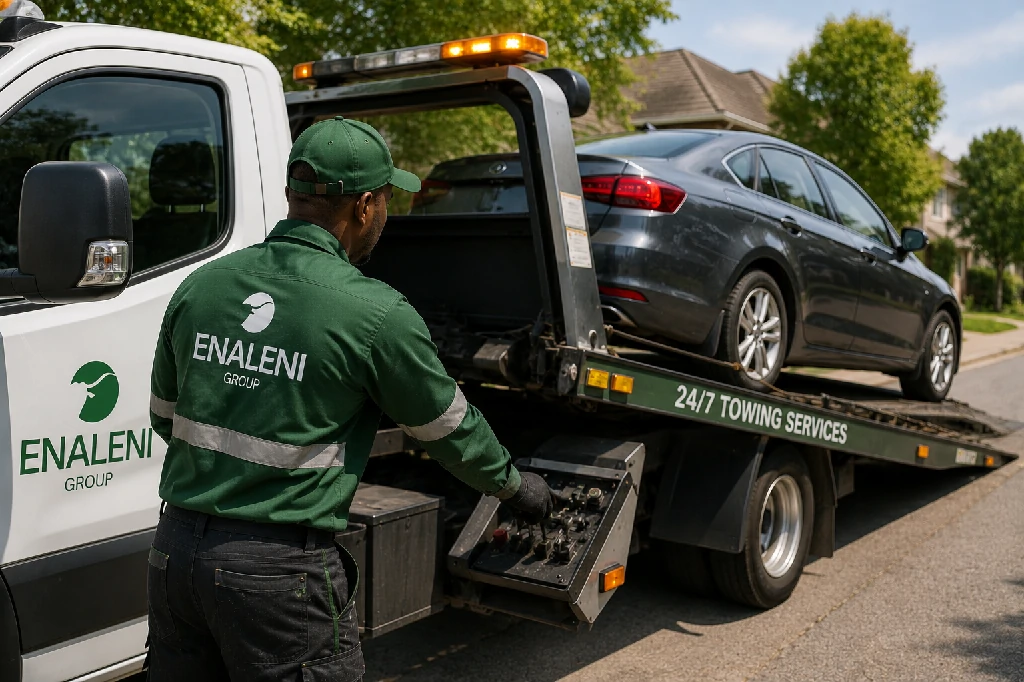
If your vehicle can’t be safely driven, arrange professional assistance.
When calling a towing service, provide important information such as:
- Your location
- Vehicle make and model
- What appears to be wrong
- Whether you’ve been involved in an accident
- Where you need the vehicle taken
- Any important access or safety information
8. Be Careful About Unsolicited Towing
If a tow truck arrives that you didn’t request, don’t automatically assume you have to use it.
Before agreeing to anything, understand who the towing operator represents, where your vehicle will be taken and what charges may apply.
If you have vehicle insurance or roadside assistance, contact your provider where appropriate to establish whether they have specific towing requirements or an approved service provider.
9. Don’t Drive a Vehicle That May Be Unsafe
Sometimes a car starts again after sitting for a few minutes. That doesn’t necessarily mean the underlying problem has disappeared.
Continuing to drive a vehicle with serious warning lights, overheating, braking problems, steering issues or obvious mechanical damage could be unsafe and may cause further damage.
When in doubt, arranging professional assistance may be the safer choice.
10. Be Prepared Before a Breakdown Happens
The best time to prepare for a breakdown is before you’re standing next to a stationary car.
Keep useful emergency items in your vehicle, such as a warning triangle, charged phone or power bank, torch and basic emergency supplies.
It’s also worth saving your insurer, roadside-assistance provider and preferred towing service contact details on your phone.
What to Do When Your Car Breaks Down in South Africa
Remember the priorities: get somewhere safer if possible, make yourself visible, protect your passengers and arrange appropriate assistance.
Don’t let pressure from other motorists encourage you to drive a vehicle that may be unsafe.